
He built every look in MAISON from the ground up. A Newark self-education, a viral moment, and a Paris apartment staged in Bushwick. This is the stylist behind the story, in his own words.
By L’Officiel Monaco
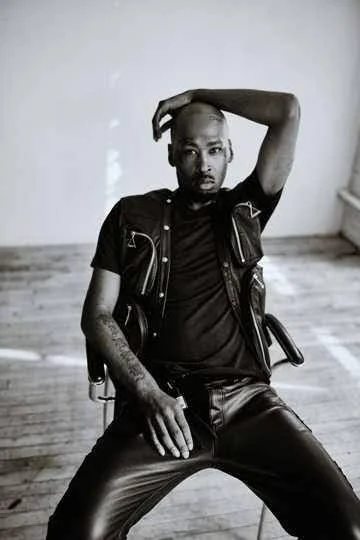
Dorian Jihad, stylist and creative force behind MAISON, photographed by Jesus Baez on set. Studio CLYX III, Bushwick.
The room in Bushwick has been dressed to pass for a Paris apartment that someone actually lives in. Warm plaster walls the color of café au lait, a brass floor lamp, a low ceramic vase, afternoon light arriving sideways and slow. Shia stands against the wall in a patent-leather corset dress and a crystal collar, a black trench falling open from her shoulders, and Dorian Jihad is beside her with one hand on the coat’s lapel, moving it a half inch at a time until it breaks exactly where he has already decided it will break. He does not hurry the gesture. Nobody in the room asks him to.
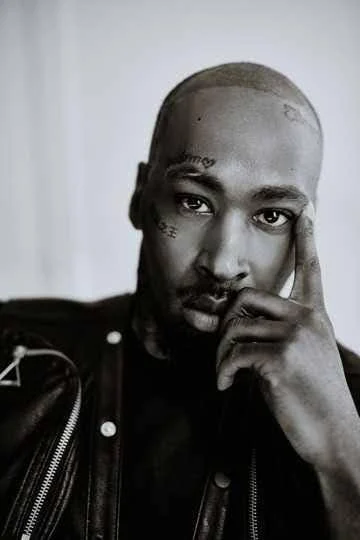
This is MAISON, the Fall/Winter story L’Officiel is running out of Studio CLYX III, and Dorian is the American stylist who built every look in it. At a moment when fashion keeps promising to make room for new names and rarely does, he is one of the few actually walking through a door he pried open himself. Self-taught, from Newark, thirteen years into a career most people are only now noticing, he styles the way he talks: deliberately, with a point to prove and the receipts to prove it.
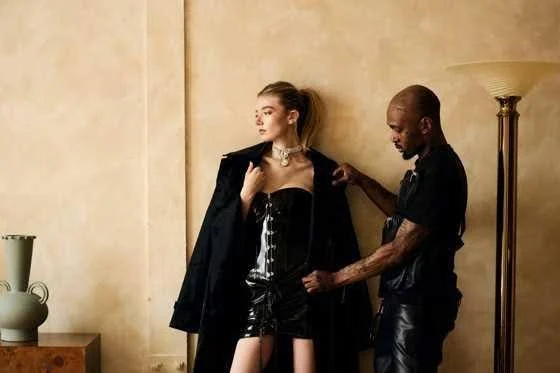
The moment the look lands. Dorian sets the trench over Shia’s corset dress. Black wet-look corset mini and oversized trench, Dorian Jihad Archive, head to toe; crystal collar, stylist’s own.
NEWARK, FIRST
Ask him where the eye came from, and he goes back to Newark, to a boy who laced his shoestrings in a pattern nobody else had because it was new, because it was his. “Style meant being able to spark a conversation in any room you entered without saying a single word,” he says. He was told young that your appearance is the first thing people notice when they meet you. “That little fashion-loving boy from Newark still takes his own approach. He doesn’t follow anyone’s footsteps. He carves his own lane as freely as he chooses.”
“No matter how talented and ready I am, I hear more no’s than yes’s. With that being said, I make it work.”
— Dorian Jihad
The lane has never come with a budget. When Dorian starts a project, the first question is not what the look is; it is where the pieces will come from. “As a young Black stylist, options are limited when it comes to pulling,” he says, plainly. So he turns the margins into an advantage. Independent designers. Smaller showrooms. Vintage consignment. Pieces he has, more than once, redesigned or reupholstered himself so a look could close the way he saw it in his head. In MAISON, that instinct runs right through the rack: two of the four looks come head to toe from his own labels, the Dorian Jihad Collective and the Dorian Jihad Archive, built and reworked by his own hand.
THE LOOKS HE BUILT · MAISON, ON SHIA

Cognac silk halter gown, Dorian Jihad Collective, head to toe. Sculptural gold cuff, gold leaf earrings, and a croc-embossed top-handle mini.

Burgundy patent-leather jacket, Cult of Individuality, over a black dress, Dorian Jihad Collective. Gold chain-link belt and nautilus earrings.
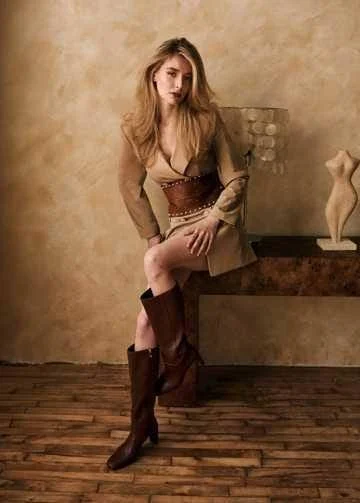
Camel blazer dress, Mrs. Momma Bear, cinched with a studded leather waist corset, Circular Path. Knee boots, stylist’s own.
THE MOMENT
The moment the industry could no longer look past arrived in 2024, and it arrived viral. Dorian styled internet sensation Onijah Robinson in head-to-toe black: high-waisted trousers, a leotard, Luar’s oversized leather bag, double-framed glasses, crocodile boots. It cleared a million views, ran in outlets between New York and Paris, and did the one thing a stylist dreams of doing for a viral subject who never had a team. “She was viral without ever having a stylist or a professional shoot,” he says. “I gave her a sense of ‘she made it.’” Luar saw the looks and reached out through Instagram. The shoot that followed, he says, is what took him to the next level.
A LANE WITH AN ADDRESS
He has since turned that lane into an institution. The Dorian Jihad Collective is his platform for the Black and brown designers, models, and producers that the official machinery kept overlooking. Rather than wait for approval, he joined the CFDA and put his own show on the calendar; thirty Black and brown models can now say they walked an official-calendar show because of it. Each season he books at least one celebrity or major influencer to walk for an emerging designer, an endorsement most wait years for, and every featured designer leaves with a magazine write-up, a press mention, and a marketing push behind their name. “I felt luxury was missing from Black fashion shows,” he says, “and culture was missing from predominantly white ones. There was a space for me to bring both together.”
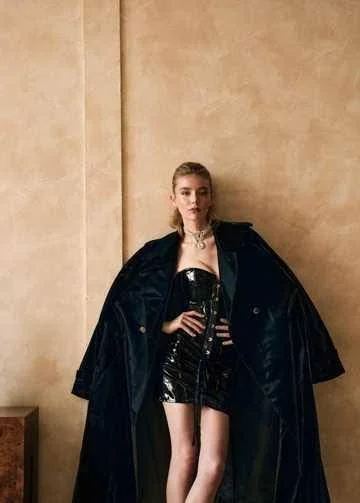
Black wet-look corset mini and oversized trench, Dorian Jihad Archive, head to toe; crystal collar necklace. Beauty by Ricardo Delgado, hair by Venecia Reyes.
“Seeing myself standing strong, by myself, is more of a testament to my story. My success is mine.”
— On where he wants his name in ten years
He is unromantic about what it costs to get here. When he pictures his name a decade out, the line he wants attached to it is about endurance as much as taste: a man who made his own lane in fashion despite everything thrown at his path. And he is not interested in borrowing anyone else’s shine to get there. “I could easily say I’d want to see Rihanna or Beyoncé in the frame,” he says of that future spread. “But seeing myself standing strong, by myself, means more.”
HELLO FROM THE OTHER SIDE
Which brings him, improbably and not at all by accident, to the Mediterranean. MAISON marks his arrival in L’Officiel Monaco, and he knows exactly what it means to land on the Riviera side of a masthead that has published fashion out of Paris since 1921. “Hello from the other side of the Atlantic,” he says, addressing a reader he has not met yet. “Most people see an overnight success. In reality, this is thirteen years of nonstop work. Even when I was denied access, I found small windows and climbed through them.” He calls the placement exactly where he is supposed to be. From most people, that would read as a line. From Dorian, who built the apartment, sourced the leather, and set the coat himself, it reads as a fact.
Back against the plaster wall, he steps away from Shia and takes in the whole frame: the coat, the collar, the light. Then he moves back in and fixes one thing nobody else would have caught. That is the job. That has always been the job. He carves the lane, and then he walks it.