
There is a moment, before a single garment appears, when a couture show reveals what it intends to be. Stéphane Rolland’s declaration was a pair of eyes four metres high, staring out over an orchestra, in a room where Dalida once sang.
By Maria Biardzka
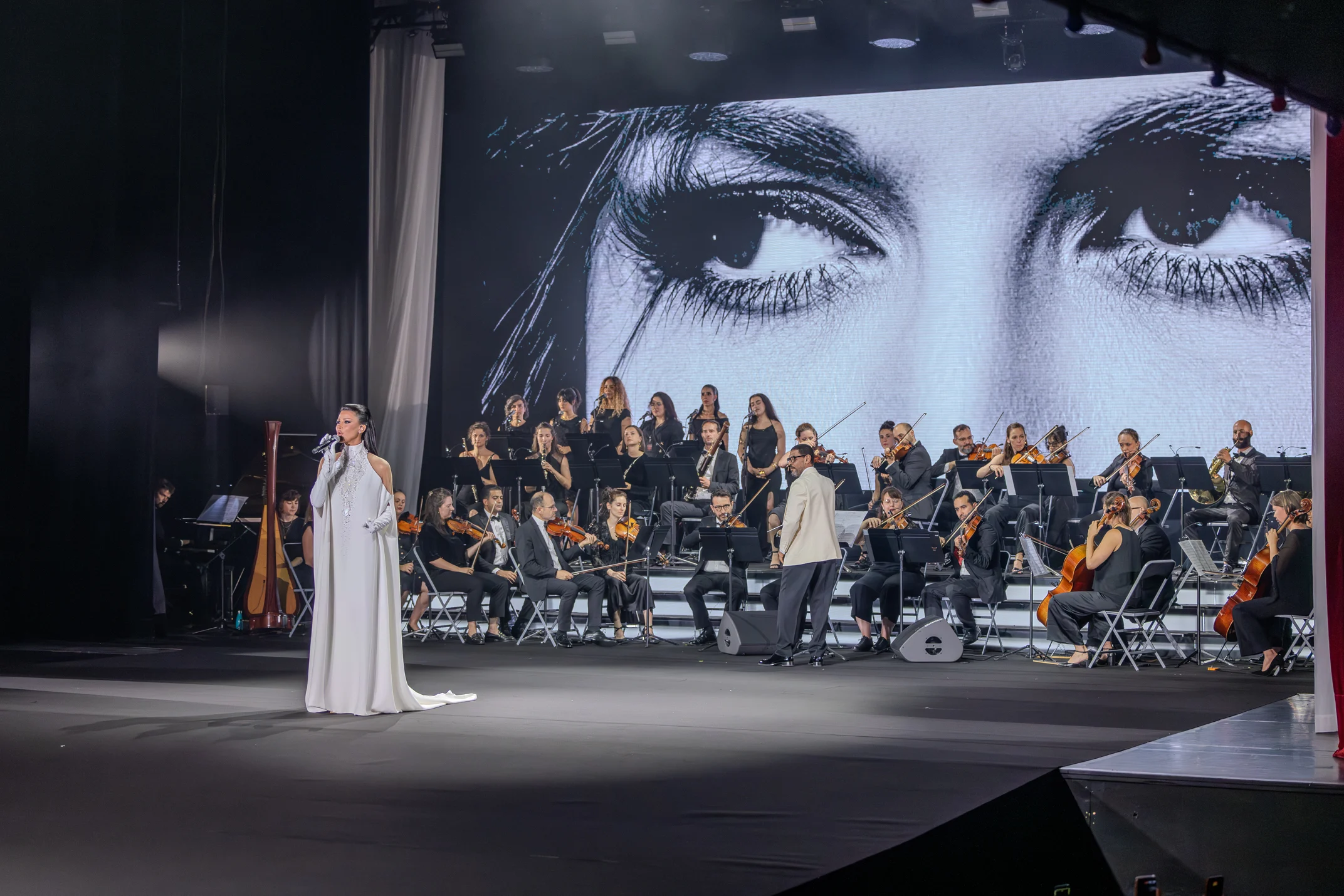
The choice of the Olympia was not a simple venue decision. Forty years after Dalida’s death, Rolland brought the singer back to the stage that made her: not through her wardrobe, not through pastiche, but through silhouette, tempo and sound. The couturier paid tribute not to a costume but to a presence, translating performance into couture rather than recreating a life. The orchestra, conducted by the Egyptian maestro Hany Farahat, played live throughout. The Tunisian singer Oumaima Taleb sang. The models walked between them.
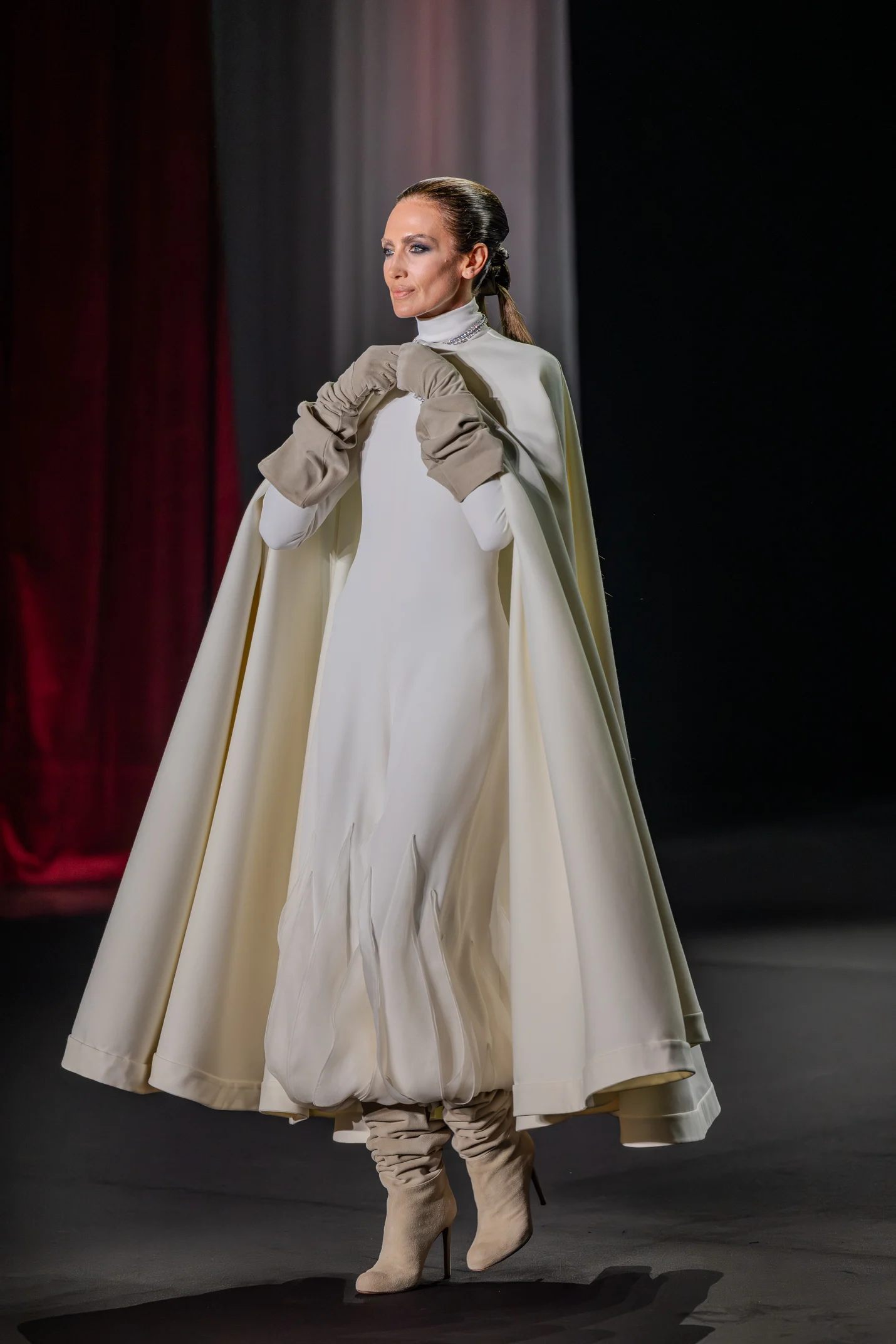
Look one set the register: a zouave trouser jumpsuit in silk crêpe and white organza under a cape of white wool gabardine, finished with a talisman necklace of black diamond, white diamond and rock crystal. Nothing about it hurried. The collection opened, and stayed for a long time, in a single luminous white: a serenity established early precisely so it could later be broken.
Behind the model, barely lit: a red curtain. It would take twenty-five looks for that red to arrive on the runway. Rolland let it wait in the wings the entire time.
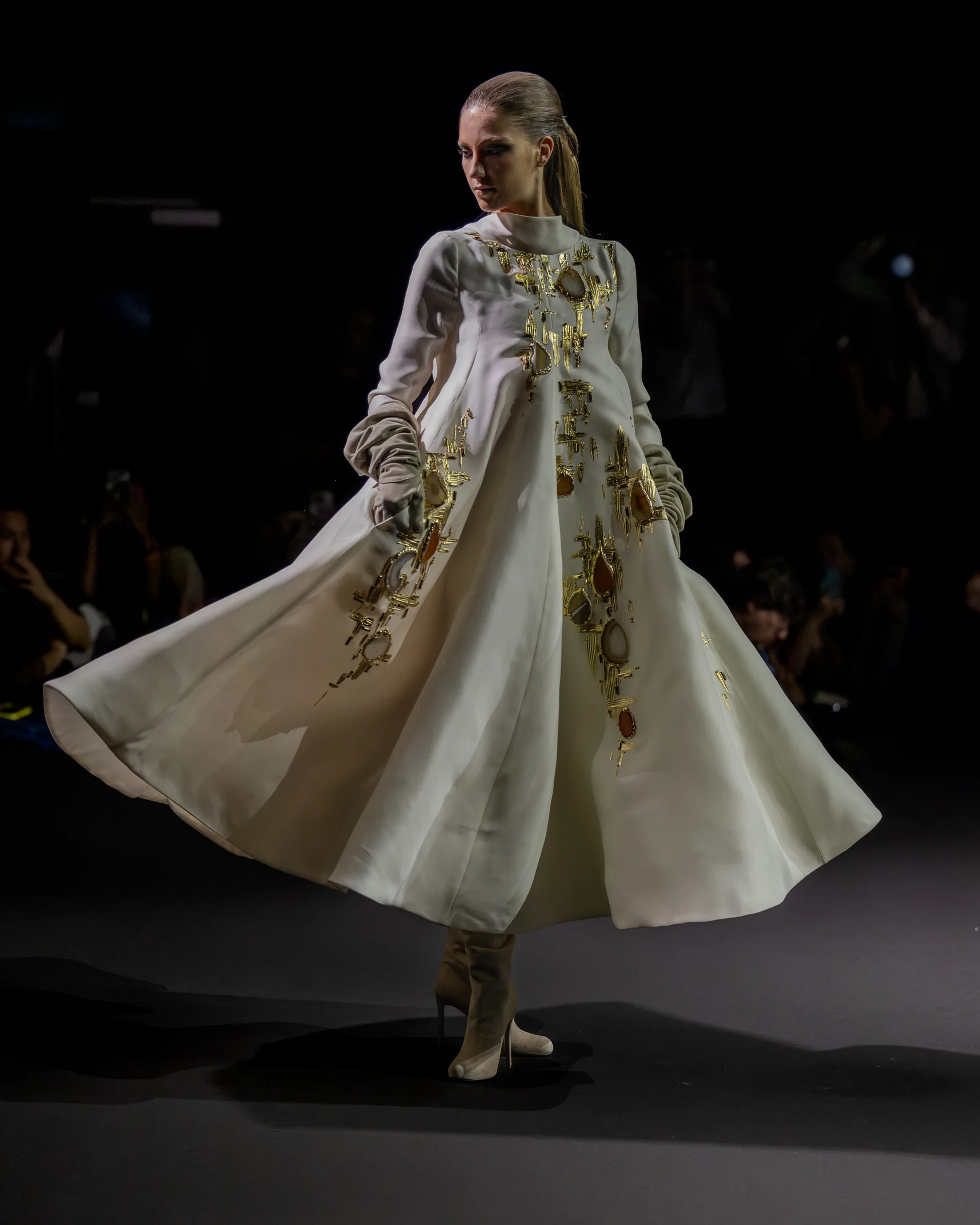
This is where the house’s hand becomes legible. A maxi trapeze dress in silk gazar, embroidered with terracotta agate and gold silicone. The stones were set not as decoration scattered across a surface, but as a fissure running down the body, as though the gazar had cracked open and revealed mineral underneath.
Rolland has always named his masters plainly: Balenciaga, Niemeyer and Brâncuși, three men who shared a gift for balance and space. You can see all three in a single turn of this skirt. The volume is architectural. The seam is sculptural. The movement is entirely Balenciaga.
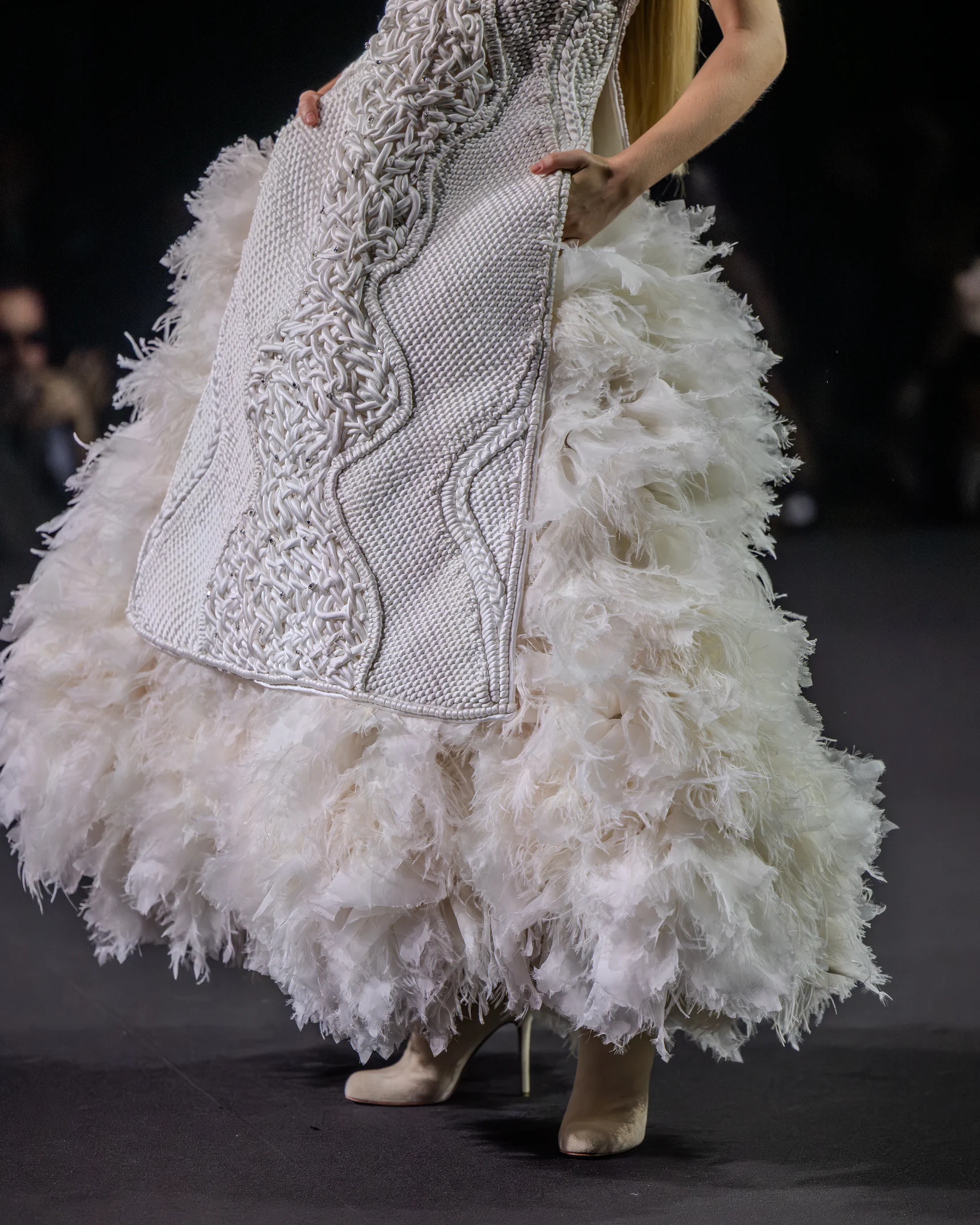
Close, the collection changes character. The bustier here is white satin macramé with handknotted cord, worked into wave and lattice, laid over an overskirt of organza ruching and white ostrich feathers. It is the kind of work that survives no photograph taken from a seat. You have to be within a metre of it.
The house has described each gown as a sculpture, cut from gazar or crêpe. On the runway, that reads as a claim about shape. Up close, it reads as a claim about labour.
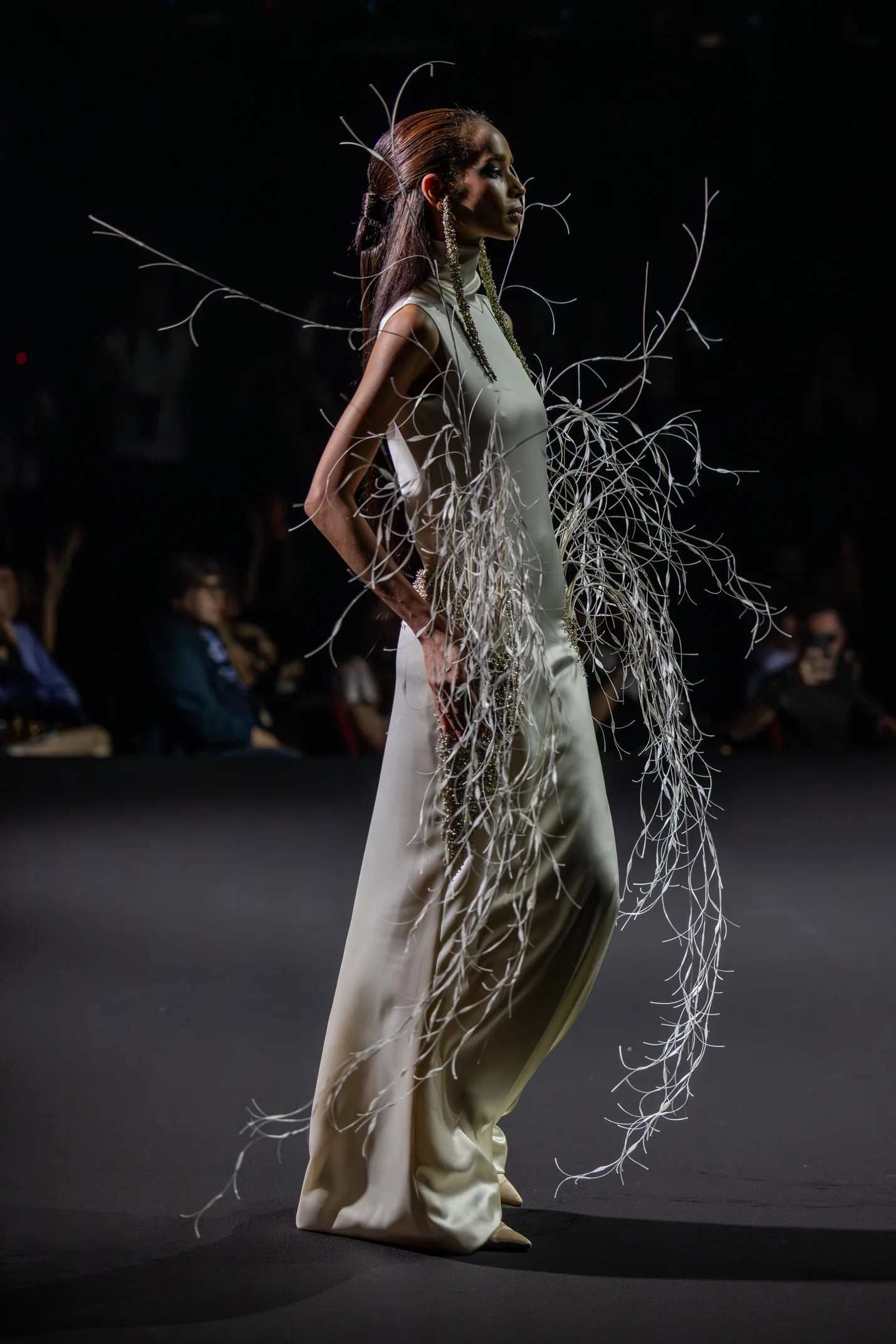
The strangest look of the show. A long sweater dress in ivory crêpe satin, embroidered with silver and crystal, with armfuls of long feathers and ivory organza strips fanning out from the body like frost forming on a window, or a nervous system, or something dredged from the sea floor. It has no obvious precedent in the collection and no obvious successor.
Rolland’s signature move, executed at full scale: an enormous curved petal of gazar folded around the torso, hard-edged, holding its shape in the air, with a burst of crystal and amethyst at the sternum where the two halves refuse to close. He calls himself an orientalist working with purity of line as much as preciousness: and the two words fight each other productively right here. The line is severe. The centre is opulent. Neither wins.
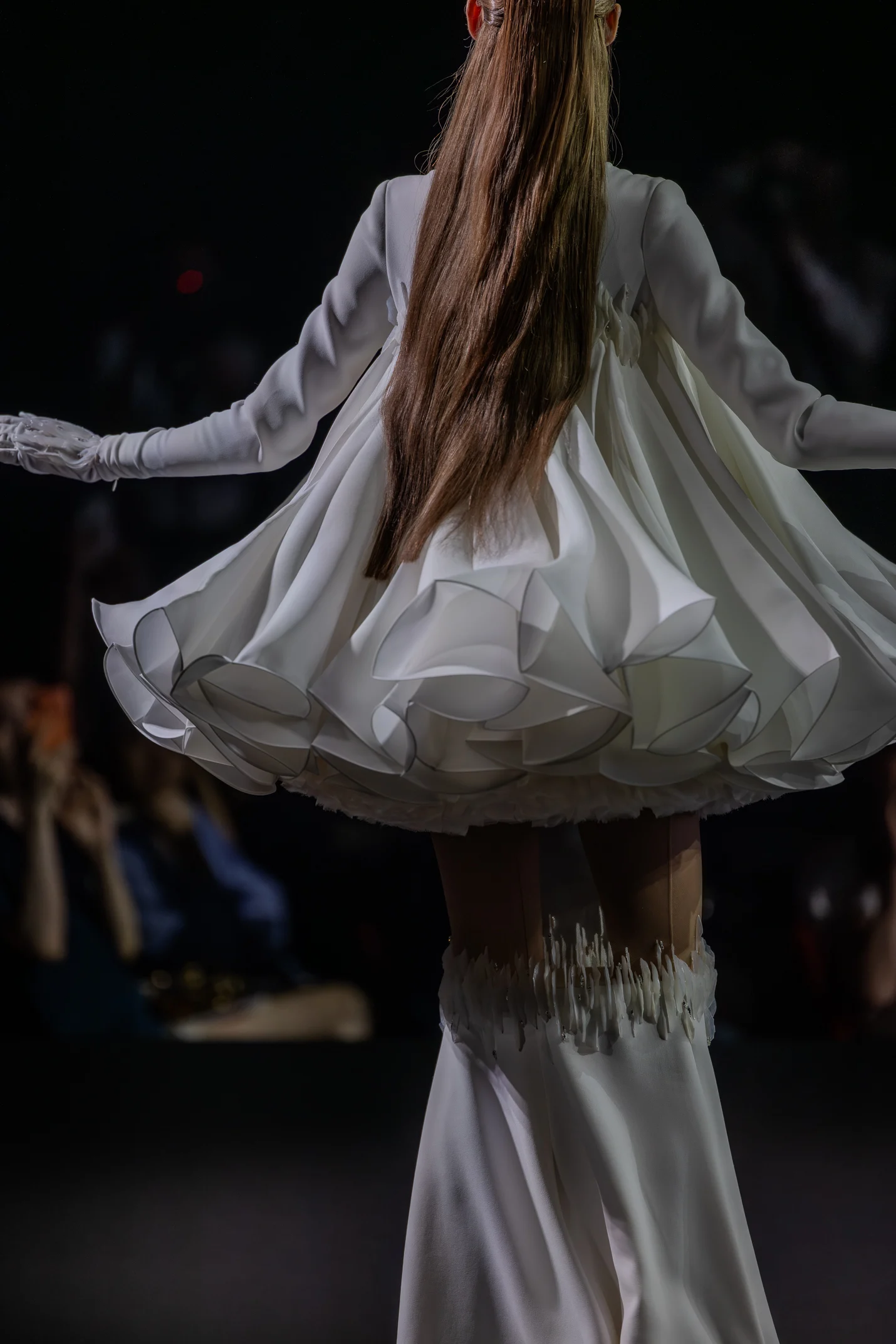
Seen from behind: a marbled silicone sweater over an arum skirt in white silk gazar, the train curling into itself like a calla lily caught mid-unfurl. Rolland’s backs are frequently more ornamental than his fronts, and he knows it. This collection sent look after look up the runway and then let them turn, so the drama arrived late.
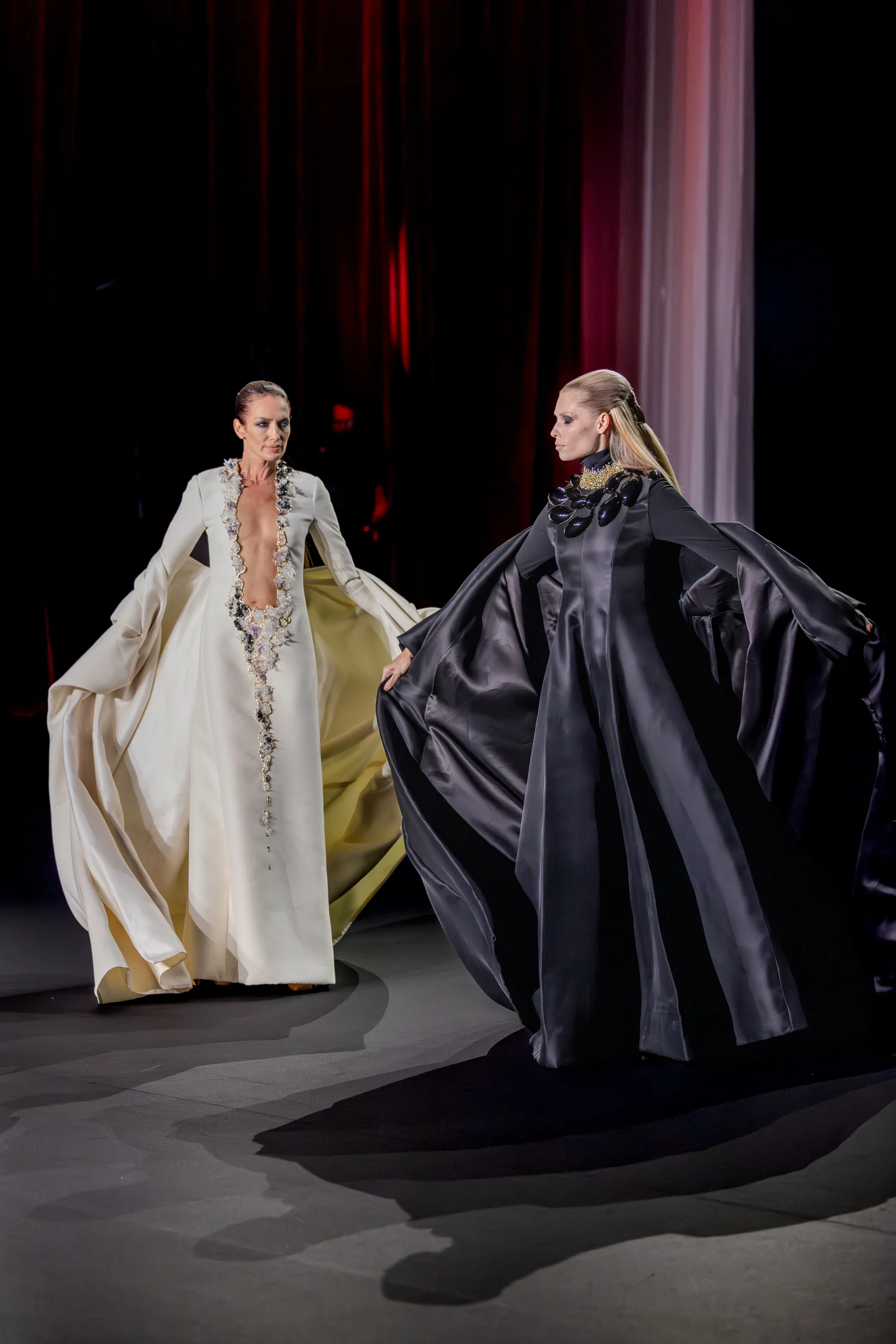
The pivot. On the left, a tunic dress in white wool gazar embroidered with rock crystal, amethyst and onyx, under a long bisht coat. On the right, black: a trouser jumpsuit in black silk gazar, embroidered with jonquil diamonds, beneath a black bisht and a sculptural necklace in black lacquered metal.
The crimson, black and metallic passages that followed introduced a contrast that mirrored the emotional register of Dalida’s own life: the public glitter and the private dark. Rolland made the shift structurally, not sentimentally. The silhouette does not change. Only the light stops passing through it.
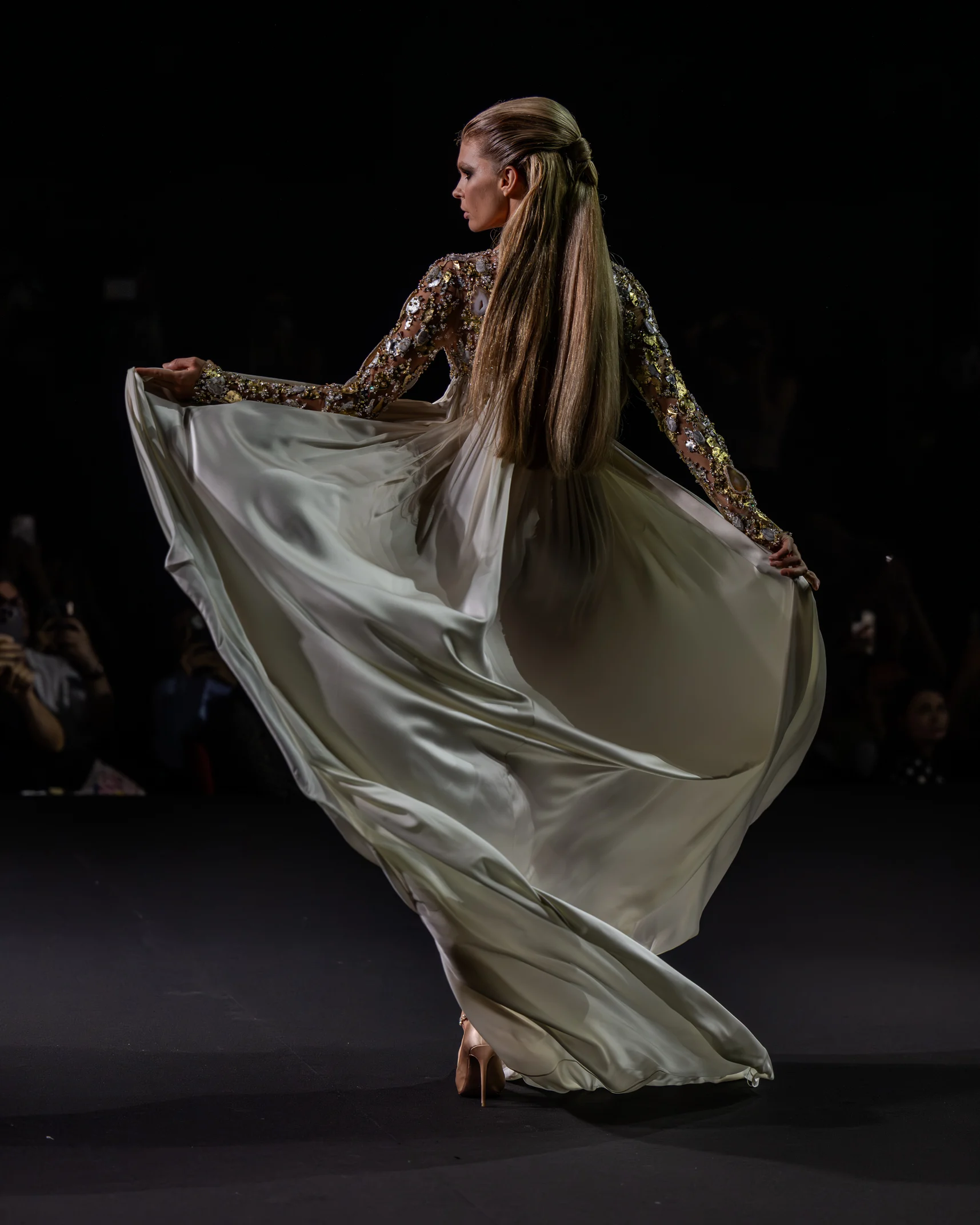
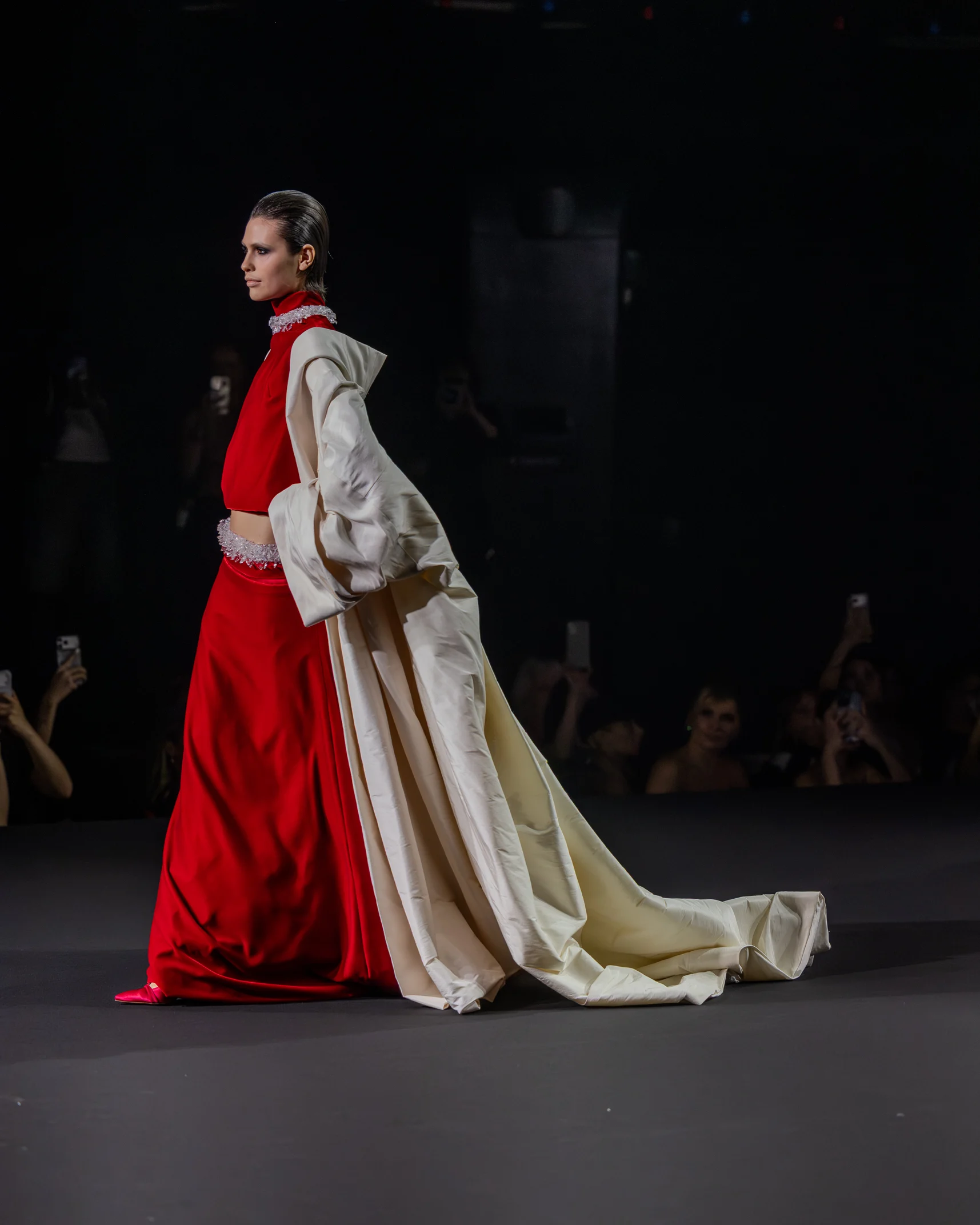
And then the red. A tunic dress and trapeze skirt in velvet, embroidered with rock crystal, under a long kimono coat in ivory shantung. The velvet has a name in the house’s own notes: Olympia. Everything in the preceding half-hour was, in retrospect, a delay of this colour. The curtain had it first.
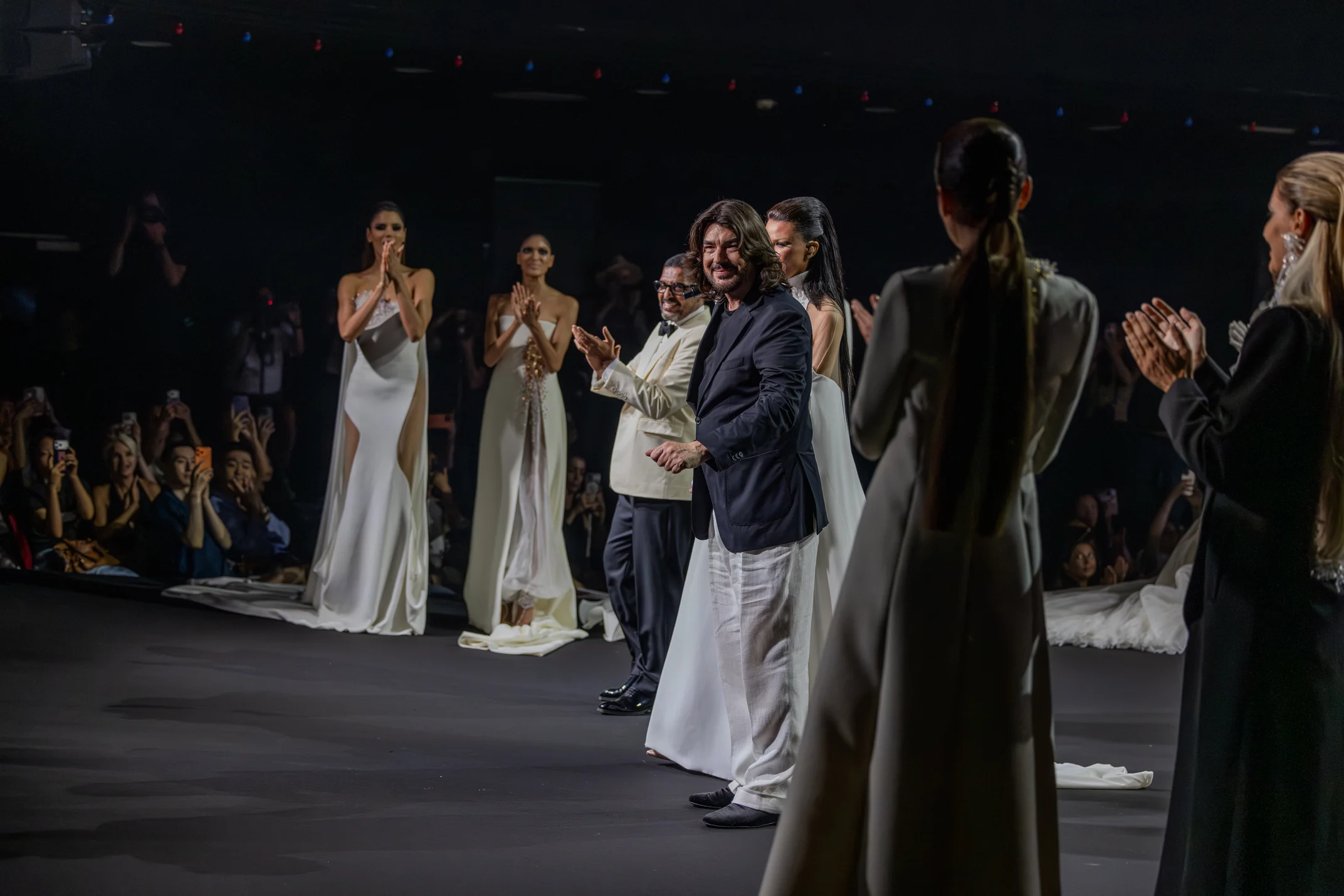
Stéphane Rolland Haute Couture Fall/Winter 2026-27 was presented at the Olympia, Paris, during Paris Haute Couture Week.
When Rolland walked out to join Taleb, the applause was for something larger than a collection. The Olympia is a room built for voices, and for one evening it was given back to one.
He opened his own house in 2007, having been, at twenty-one, the youngest artistic director in Paris. Nineteen years on, the sharpest thing about this collection is not the embroidery or the gazar or the mineral seams. It is the restraint of a designer who understood that the most direct way to summon a singer is not to dress her, but to build a silence, fill a stage with an orchestra, and let the audience notice who is missing.