
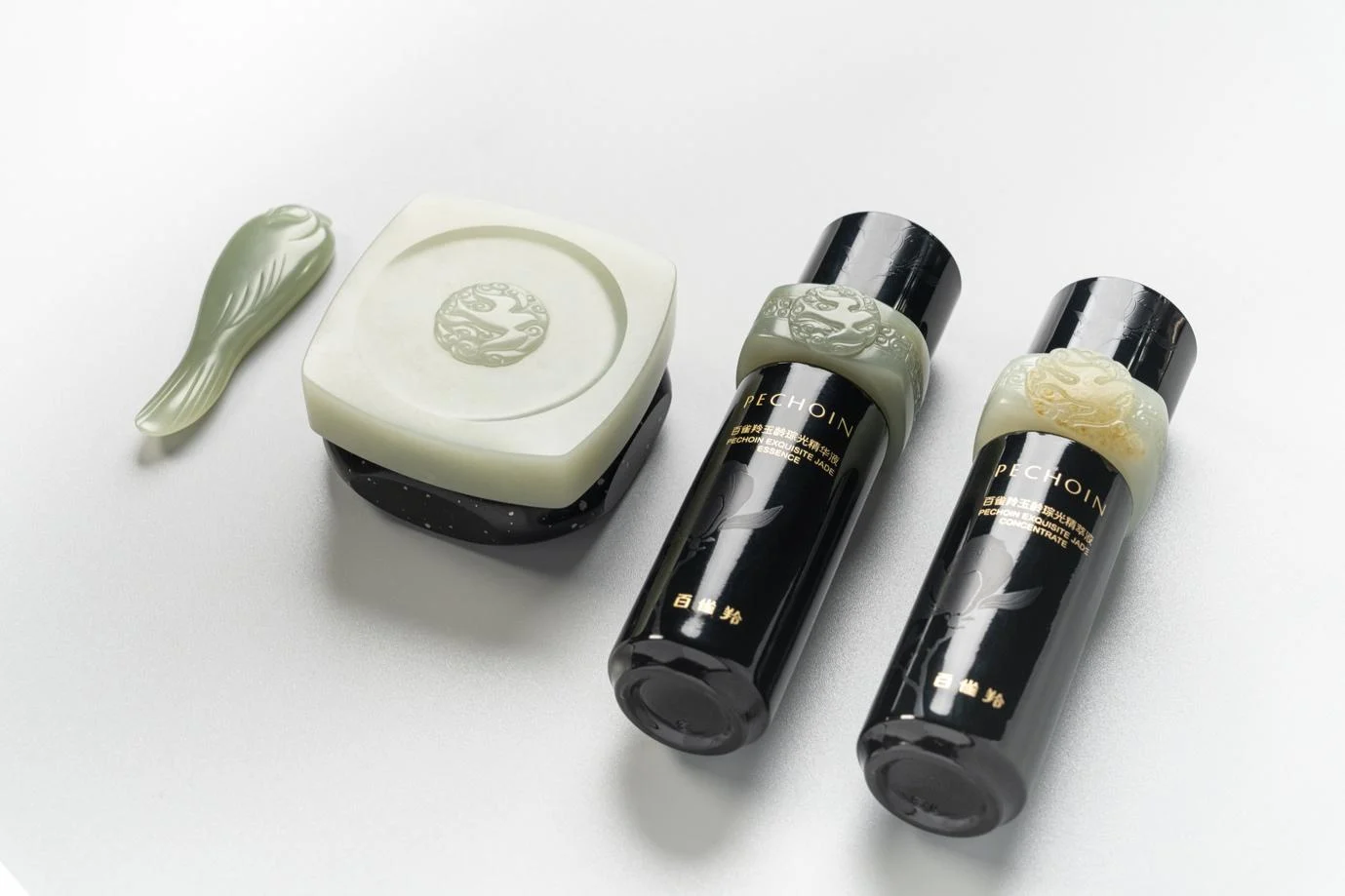
In recent seasons, jade has been reappearing in Western fashion. From accessories to runway references, the stone is treated as an exotic accent for being visually striking and culturally suggestive. That context makes one moment from China Guardian’s Autumn Auction especially intriguing: a skincare vessel carved from Hetian jade, created by a Chinese brand, sold for nearly RMB 1.1 million (approximately USD 150,000).
The sale raises an uncomfortable question for the global luxury industry. When a cosmetic object enters an auction space traditionally reserved for fine art and antiquities, are we witnessing clever marketing or the emergence of a different value system altogether?
When a Cosmetic Product Becomes a Collectible
The piece in question was a jade cong-inspired vessel produced by PECHOIN in collaboration with Cheng Lei, a master of Suzhou jade carving. Its form references one of China’s earliest ritual objects, historically associated with cosmology and order.
At China Guardian, an auction house better known for calligraphy, classical painting, and imperial artifacts, the skincare product was framed as a collectible. For outside observers, the surprise is not the craftsmanship, nor even the material. It is the institutional validation.
Auction houses function as cultural gatekeepers: what they accept, they implicitly legitimize. In this context, the hammer price suggests that certain Chinese consumers and collectors are prepared to evaluate contemporary branded objects through the same lens as cultural artifacts.
Globally, Christie’s and Sotheby’s also generated billions of dollars in sales, a sign that traditional art markets see renewed interest. In 2025, combined global auction sales at Sotheby’s and Christie’s reached $13.2 billion, up from $11.7 billion the year before.
Symbol Extraction vs Cultural Interpretation: How Oriental Elements Are Consumed in Fashion
The contrast with Western luxury is instructive. International maisons have long incorporated jade into jewelry and accessories, typically emphasizing color, rarity, or symbolic associations like luck and prosperity. The stone is extracted from its cultural system and redeployed as a design element.
In this case, jade was not treated as an accent but as the conceptual core. The object’s value rested less on visual novelty than on philosophical reference: ideas of balance, permanence, and ritual continuity. Whether international audiences fully grasp those layers is another matter, but the intent marks a clear departure from how “oriental elements” are usually consumed in fashion.
For PECHOIN, the auction was the part of a longer strategy that positions the brand less as a cosmetics company and more as a cultural participant. Over recent years, it has collaborated with heritage artisans, museums, and historical institutions, repeatedly testing how far a skincare brand can move into symbolic and collectible territory.
Still, the auction result should not be read as a universal endorsement. As several art market analysts have noted, such crossover objects exist in a fragile space: part cultural experiment, part market spectacle. How much of the RMB 1.1 million reflects belief in longterm cultural value and how much reflects momentary enthusiasm is an open question.
Is This a Shift in China’s Luxury Value System?
What the sale undeniably shows is a change in domestic consumption psychology. Among a new generation of Chinese high-net-worth buyers, luxury is increasingly defined by cultural fluency rather than brand legacy alone. Ownership becomes a statement of interpretive authority: understanding the reference matters as much as affording the object.
For global luxury houses, this presents both a challenge and a provocation. If value is no longer anchored exclusively in Western histories or universally recognized gemstones, the competitive landscape shifts. Cultural depth that was once treated as narrative garnish may become the main currency.
The Auction Raises a Real Question
The jade vessel has found its owner, but the broader conversation is just beginning. Can culturally dense objects like this travel beyond their original context without being flattened or exoticized? And are global luxury brands prepared to engage with Eastern narratives not as inspiration, but as equal systems of meaning?
The hammer has fallen. What remains unsettled is whether the future of luxury will continue to be narrated from a single cultural center or new voices carrying their own philosophies are ready to reshape the story.
Click the link below to learn more.
Pechoin Official Website
Image credit: Pechoin