
Painting has come back into the contemporary conversation, but most of what fills the new figurative galleries is either technically thin or conceptually loud. Elena Von Kohn occupies a stranger space than either. Her canvases are technically rigorous in a way the academy used to demand, and the market mostly stopped rewarding. They are also psychologically unresolved in a way that resists the easy reading the gallery wall text usually provides.
By Angela Cordoba Perez
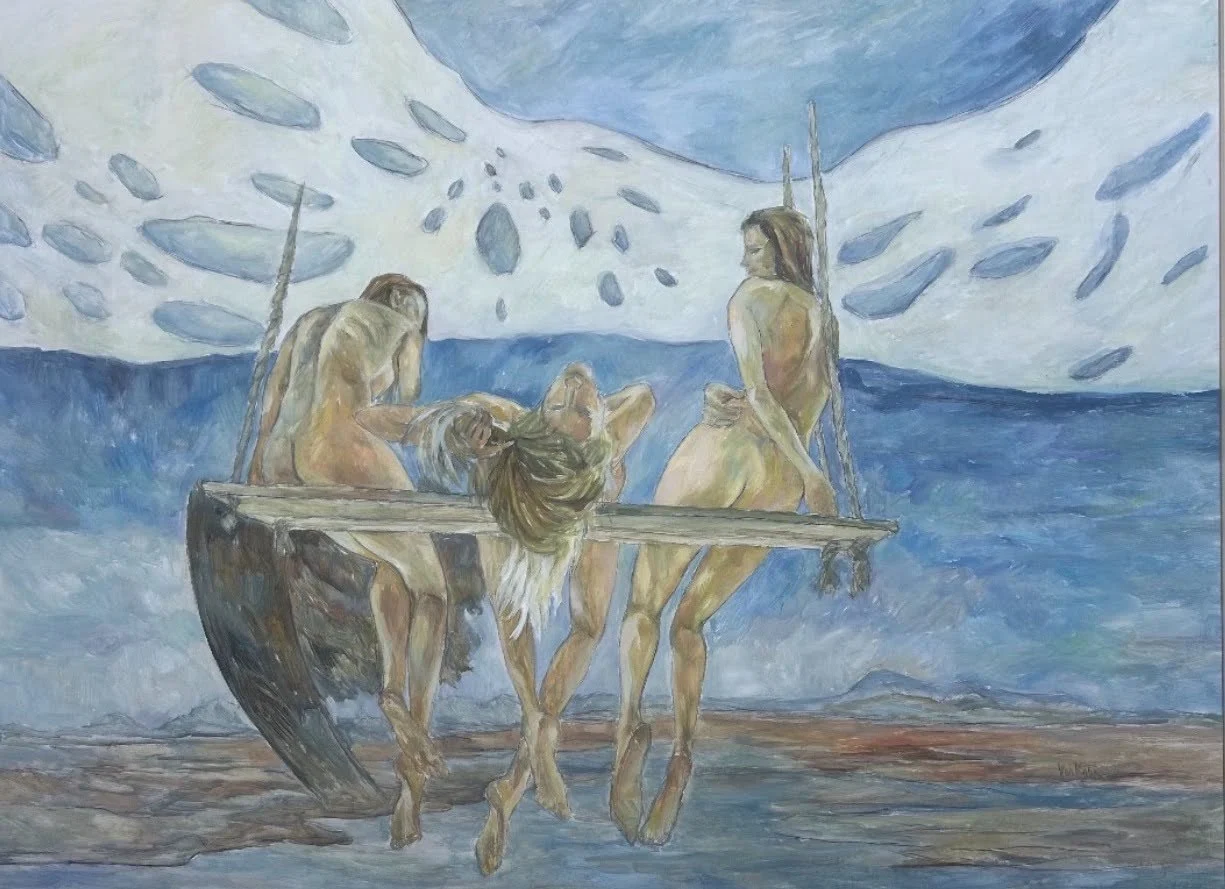
Photo courtesy of Elena Von Kohn
She has a name for what she does. She calls it enigmatic surrealism. The distinction matters because the term signals a position.
Not The Surrealism You Think
The Surrealists of the 1920s were preoccupied with dream-imagery as content: clocks that bend, eyes that float, the unconscious staged as visual spectacle. Von Kohn is preoccupied with something quieter. Her paintings do not depict dreams. They produce the sensation of having had one, then trying to describe it to someone over breakfast, and realizing the words are wrong.
The figures in her work are precisely rendered. The musculature is correct, the perspective is studied, and the light obeys the rules she learned at the Moscow academy in her early training. What is uncertain is what those figures are doing emotionally. A woman seated on a bed could be waking up or could be deciding not to. A figure in profile is either pulling away or leaning in, and the painting does not adjudicate. “I’m interested in what cannot be fully explained in words,” she said. The unresolved gesture is the work.
The Female Figure
Most of Von Kohn’s paintings center on the female form. In a contemporary art world that has spent the last decade arguing about how women should be depicted, this is a position that requires defending, and Von Kohn defends it by refusing to make her women symbolic. They are not stand-ins for ideas about identity. They are not vehicles for narrative. They are present, psychologically dense, and disinclined to explain themselves to the viewer.
What she has built is a visual language in which the female figure carries psychological weight without being asked to deliver a message. The result is paintings that invite a dialogue rather than offering a resolved narrative — a description of her own working notes return to repeatedly, and one that holds up in front of the canvases.
The Classical Foundation, In Service Of Something Contemporary
Von Kohn’s training was European and academic: Leipzig, then Moscow, then the slow build of a working practice across studios in Scottsdale and San Diego. The technical discipline visible in her paintings is what she learned to do before she learned what she wanted to say with it.
Collectors describe a quality of permanence in Von Kohn’s canvases — a sense that the paintings will hold up under repeated looking. Curators describe a coherence of visual language that survives across years of output. Both observations point to the same underlying fact: a technique that disappears into the work is harder to fake than a technique that announces itself.
The European lineage shows up in her own framing of the Paris show. “The emotional and visual language behind this work was born from a European tradition,” she said of L’Instant du Rêve, which opens at Galerie Joseph on June 10. The exhibition gathers her most recent series — monumental in scale, classical in execution, and unresolved in tone. It is the natural arrival point for a visual identity that has been quietly consolidating across continents.