
There is a tendency to think of legacy in material terms: buildings, collections, fortunes, institutions. Yet the most enduring inheritance may be something far less tangible. It is culture, the ideas, stories, traditions, conversations, and creative expressions that survive long after their creators are gone. For writer and cultural thinker Anna Mansour, culture is not simply a reflection of society. It is society’s most valuable form of continuity.
By Luc Durant
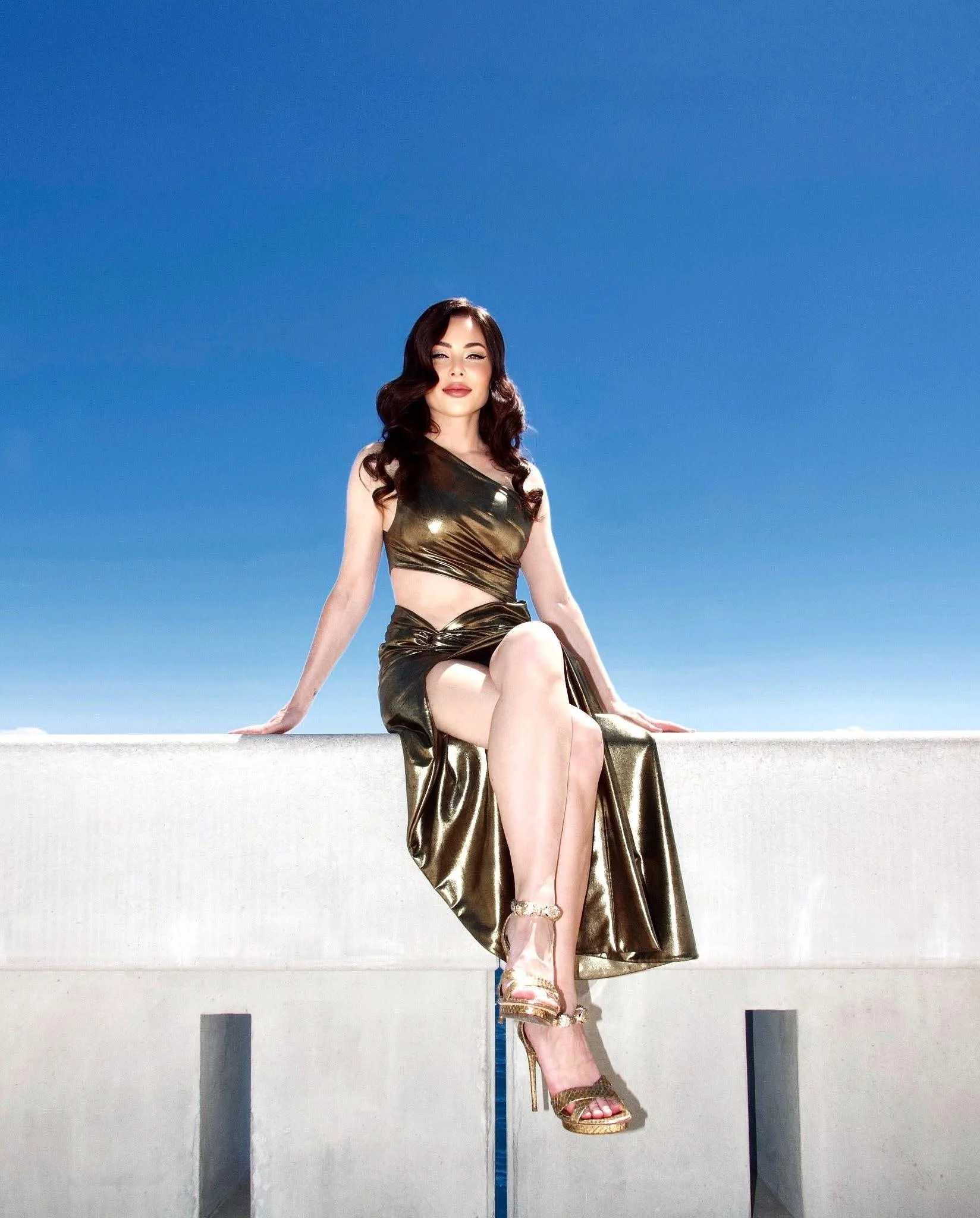
Hair & Makeup by Glam Monte Carlo; Photography by © Don’t Call Me Darling
There is a tendency to think of legacy in material terms: buildings, collections, fortunes, institutions. Yet the most enduring inheritance may be something far less tangible. It is culture, the ideas, stories, traditions, conversations, and creative expressions that survive long after their creators are gone.
For writer and cultural thinker Anna Mansour, culture is not simply a reflection of society. It is society’s most valuable form of continuity.
Moving between Monaco and an increasingly international cultural landscape, Mansour has developed a body of work centred on a question that feels particularly urgent today: what do we choose to preserve, and why?
At a time when information is produced in unprecedented quantities and attention has become one of the world’s most contested resources, she argues that culture deserves to be approached not as content, but as inheritance.
“The greatest legacy we leave behind is cultural,” Mansour has said. “Everything else eventually follows.”
The Value of What Endures
Contemporary culture is often measured by visibility. Success is quantified through engagement, reach, and speed. Yet visibility and permanence are not the same thing. Mansour’s writing repeatedly returns to the distinction between what captures attention and what survives it.
Digital platforms create the illusion that everything is preserved forever. Yet archives disappear, technologies become obsolete, and context is routinely lost. What remains accessible is not always what remains meaningful.
For Mansour, preservation is therefore not merely a technical exercise. It is a cultural responsibility.
The challenge is not simply storing information, but maintaining understanding. Future generations do not inherit culture through files and databases alone; they inherit it through interpretation, dialogue, and care.
This belief forms the foundation of what she describes as cultural slow substance: the conviction that meaningful culture requires time to develop, time to be understood, and time to endure.
Culture as Living Memory

Hair & Makeup by Glam Monte Carlo; Photography by © Don’t Call Me Darling
Mansour rejects the notion of preservation as a static act.
Culture, she argues, is alive. It evolves through every generation that encounters it. Preservation is therefore less about freezing ideas in place and more about ensuring they remain legible as the world changes around them.
This perspective becomes particularly relevant as artificial intelligence increasingly shapes cultural production. While new technologies are transforming how creative work is made and distributed, Mansour remains focused on a deeper question: how do we preserve human meaning within systems designed for scale?
Her answer is neither resistance nor nostalgia. Instead, she advocates for stewardship.
The future of culture, she suggests, will depend not on how much we create, but on how thoughtfully we carry forward what already exists.
Rodomontade and the Art of Continuity
This philosophy finds its most visible expression in Rodomontade, Mansour’s hybrid cultural platform and printed periodical.
Conceived as both a publication and an intellectual gathering place, Rodomontade operates as a contemporary forum for artists, writers, and thinkers. It offers something increasingly rare: a space where ideas are allowed to mature.
Part archive, part salon, part cultural observatory, the project is built around continuity rather than immediacy. Conversations are extended rather than concluded. Ideas are revisited rather than replaced.
Its ambition is not simply relevance, but longevity.
In doing so, Rodomontade reflects a larger belief at the heart of Mansour’s work. That culture flourishes when it is given the conditions to endure.
The Elegance of Care

Hair & Makeup by Glam Monte Carlo; Photography by © Don’t Call Me Darling
Perhaps the most distinctive aspect of Mansour’s philosophy is her insistence on care.
In a culture that rewards speed, care can appear inefficient. Yet history suggests otherwise. Every enduring cultural achievement — whether a work of literature, a tradition, an institution, or a movement — has depended on sustained attention.
Care is what transforms information into knowledge, and knowledge into legacy. It is also what allows culture to survive periods of rapid change.
Across her writing, Mansour proposes that preservation is not a backward-looking act. It is among the most future-oriented practices available to us. To preserve culture is to invest in a future audience we may never meet.
What We Leave Behind

Hair & Makeup by Glam Monte Carlo; Photography by © Don’t Call Me Darling
The question of legacy has always occupied a central place in human history. Yet in a world increasingly defined by speed, it has acquired new significance.
For Anna Mansour, the answer remains remarkably clear.
The most valuable inheritance is not what we own, but what we pass on. Not wealth, but wisdom. Not accumulation, but continuity.
Culture remains humanity’s longest conversation, and preserving it may be the most important responsibility we share. Because long after attention fades, culture is what remains.