
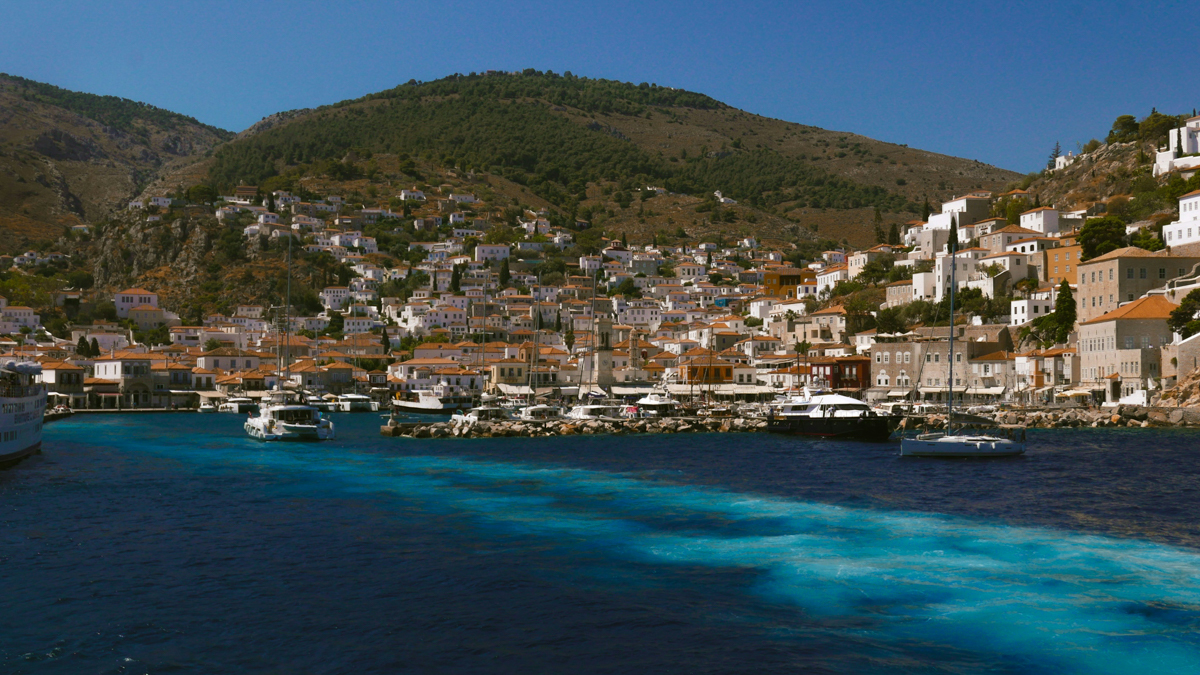
Around 80km south of Athens, on the Aegean Sea, lies the quaint little island of Hydra. With its charming combination of rolling green hills and beaches, the sound of donkey hooves clacking on cobblestones and the restaurants overlooking the port, it makes for a compelling touristic destination. But there is something that sets this island apart from others: at its heart lies a history rooted in art and creativity, which remains present to this day.
As summer rolls around, the usually idyllic island of Hydra, Greece, is disrupted by crowds flooding in on ferries, boats and yachts from all around the world. June is a busy month, as the island celebrates the Miaoulia Festival and two exhibition openings: the Hydra School Project and the DESTE Foundation for Contemporary Art. The latter, founded by famed collector Dakis Joannou, has been taking place in the old slaughterhouse since 2008. This year’s “Dream Machines” was curated by Daniel Birnbaum and Massimiliano Gioni and featured celebrated artists both contemporary and historical, such as Jeff Koons, Marcel Duchamp, Lee Bul and Pipilotti Rist. The underlying theme was the relationship between technology and humans and was beautifully explored by the many artworks in the symbiotic installation.

The audience who attend this illustrious event like to take advantage of the island’s scenery. As such, the days leading up to and after the inauguration are packed with glamorous events. This year included a book signing by Koons, a panel discussion, an impromptu yacht party and late nights at the creatives’ favoured place for drinks, The Pirate Bar. Koral Jones, who DJ’ed the island’s hottest yacht party says it was “Like a trip to the universe next door”.


But how exactly did Hydra become a magnet for all things art-related? To understand the island’s appeal, its history must be unravelled.
The picturesque island has attracted artistic people, such as Swedish author Fredrika Bremer, since as early as the 19th century. Cubist artist Nikos Hadjikyriakos-Ghikas’ 18th-century family home hosted numerous creatives from the 1930s to the 60s when the mansion burned down. Guests included Nobel laureate Giorgios Seferis, George Katsimbalis, Patrick Leigh Fermor, Lawrence Durrell and Henry Miller, who wrote his novel The Colossus of Maroussi while visiting. The ruins of the famed house are still visible above the village of Kamini, hidden in the hills.

In 1936, the School of Arts was founded, and there stayed figures such as Chagall and Pierre Daninos. The 1950s marked the arrival of author Gorden Merrick, while in the 60s, renowned singer Leonard Cohen discovered the island through the Rothschilds. Once on the island, he fell in with Australian writers George Johnston and Charmian Clift and stayed in Hydra’s bohemian community for seven years. Notable movies were shot on the island during this era, such as Michael Cacoyannis’ “The Girl in Black”, Jean Negulesco’s “Boy on a Dolphin” (starring Sophia Loren) and Jules Dassin’s “Phaedra”. This attracted celebrities such as Brigitte Bardot and Jackie Kennedy.
Hydra’s beauty and legacy have been represented throughout the years in all mediums of art, from literature to painting to film. As such, the island is forever solidified as a haven and source of inspiration for creatives worldwide, who continue to flock to it every year.
Image credits:
Paulina Grishina
Svetlana Grishina
@artflyernet on Instagram