
After meeting in 1917, Pablo Picasso and Gabrielle “Coco” Chanel forged a friendship that would last for years, and a professional relationship emerged, resulting in two powerful artistic collaborations.
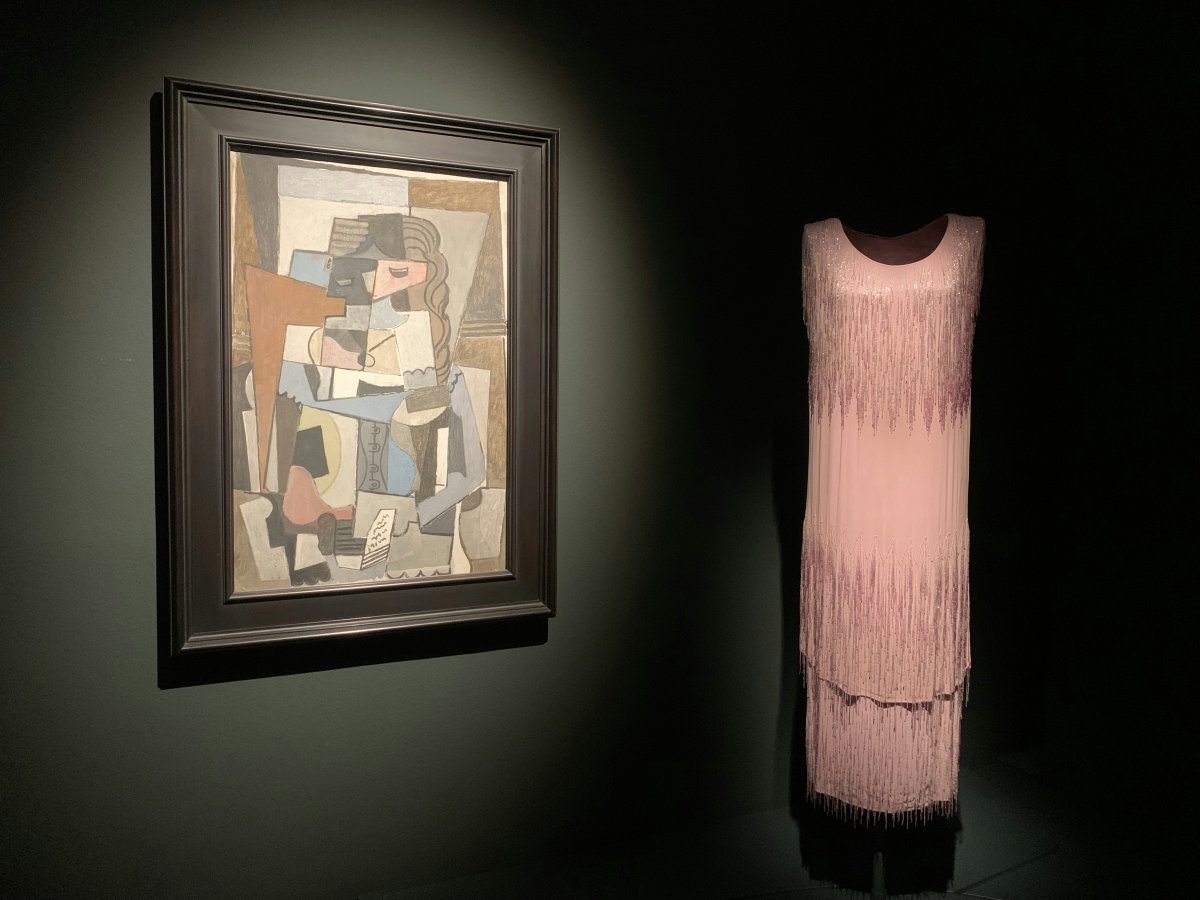
Fashion and art have always found their way together. One cannot conceive one without the other, as they feed off each other. This is provable in every era, yet the 20th century was the one to ascertain how much they both contribute to the development of one another.
Chanel and Picasso were two creative minds who demonstrated this point. They both enriched their own sectors with their creations and showed how connected two creative minds as cultured and abstract as theirs could be.

Credits: Melissa Vega
That is why the Thyssen-Bornemisza Museum in Madrid has an exhibition honouring these two great masters. Visitors can delight in the creations of the painter and the couture designer and look at the connections and points of convergence between their works.
Their creations show some aspects that fashion and art share. Picasso and Chanel did not collaborate many times. Still, the similarities between their works attest to the time in which they both lived and truly demonstrate that “great minds think alike”.

Credits: Melissa Vega
The exhibition is composed of four sections. The first, Cubism and the Style of Chanel, shows the influence that Cubism and Picasso’s work had on Chanel. Different elements of this artistic movement from the beginning of the 20th century are reflected in Chanel’s creations through straight lines, two-dimensional silhouettes, sobriety, and monochrome. Chanel also used simple and low-cost fabrics at this point, which led her to gain recognition as the genius who turned cheap into luxury. She made simple materials and fabrics seem expensive through her beautiful creations.


Credits: Melissa Vega
The second section, Olga Picasso, is inspired by Pablo Picasso’s first wife. The Russian dancer was one of the great admirers of Chanel fashion, so much so that she wore a Chanel design for her wedding. In addition, in several of Olga’s portraits exhibited in this section, which were painted by Picasso, she is dressed in Chanel.


Credits: Melissa Vega
Antigone is the name of the third section of the exhibit, and it alludes to the homonymous adaptation that Jean Cocteau made of Sophocles’s play. Pablo Picasso was behind the set, the masks, and other accessories, while Chanel made the costumes for the performers. It was the first collaboration between Picasso and Chanel in 1922.


Credits: Melissa Vega
Finally, there is Le Train Bleu, the section dedicated to the ballet that bears that name, whose libretto was also written by Cocteau. This was the second collaboration between Picasso and Chanel, and interestingly, it was also through Cocteau that the partnership took place. Picasso was behind several essential illustrations for the development of the ballet, while Chanel took care of the costumes.


Credits: Melissa Vega
Chanel and Picasso admired each other’s art ever since they met at a ballet premiere when Jean Cocteau introduced them. In fact, Picasso was so enchanted by Chanel’s avant-garde designs and innovative swimsuits that he replicated them in his 1918 work, The Bathers.
Once again, these artistic masters of the 20th century demonstrated that fashion feeds as much from art as art feeds from fashion since they are closely related and complement each other.